

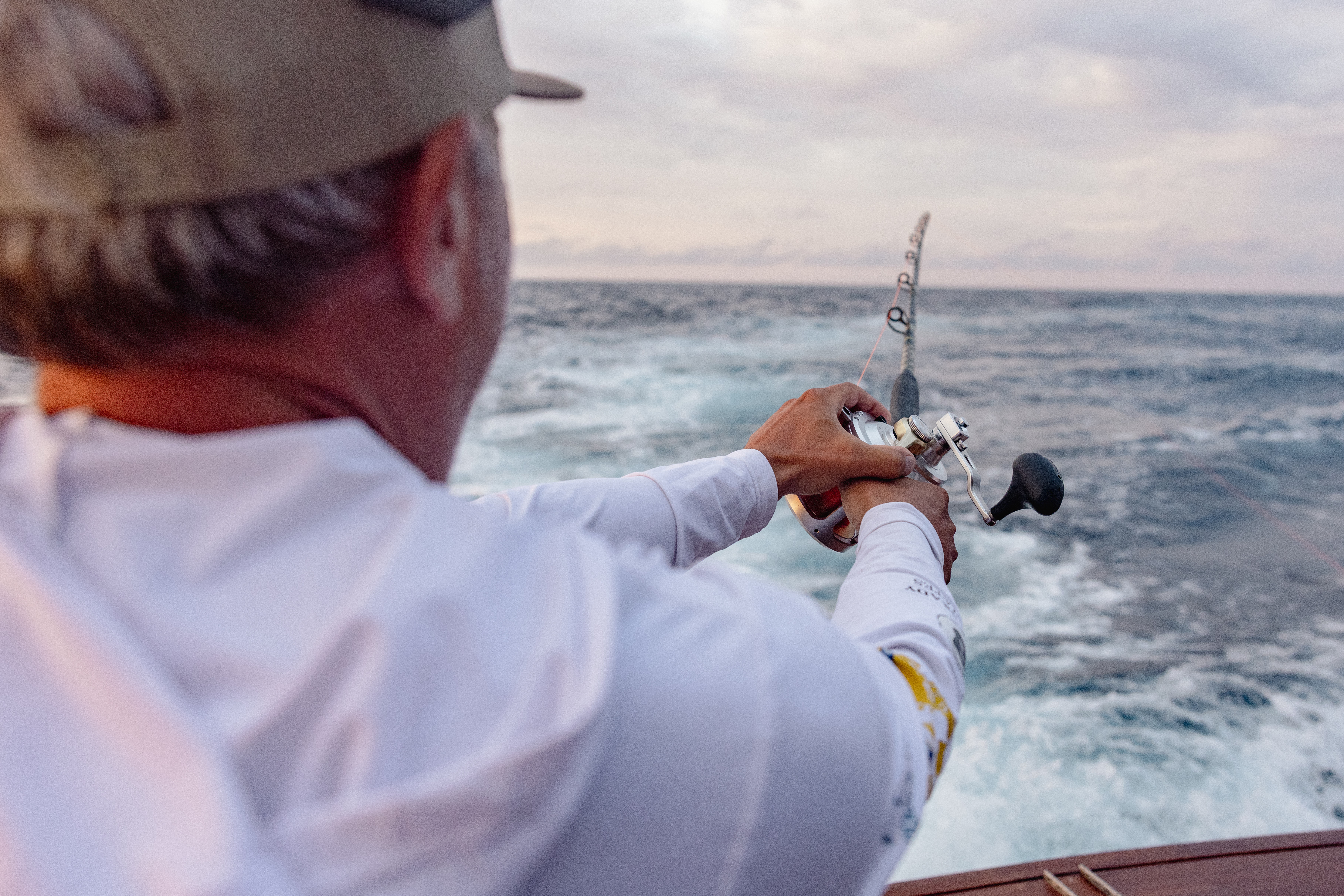
Unpacking the debate between 'Hook & Hand' and IGFA Rules
The details, arguments and ongoing homework behind one of the more controversial topics to come out of SFC League Meetings
Even before the conclusion of SFC’s annual League Meetings, which took place last week in Dallas, Texas, we had a good feeling where the most (animated) debate would take place: The Competition Committee.
Meeting on Wednesday, December 3 at the Hilton Dallas/Southlake Town Square, one topic in particular sparked the most emotion from within the room and across the league’s competitors: The vote between keeping “hook & hand” provisions or using the more stringent International Game Fish Association (IGFA) ruleset where an angler must hook their own fish.
The two camps were as passionate in their attacking and defending as we saw across the sportfishing community earlier this year regarding production sportfishing boat builders versus custom boat builders.
Before we dive into the debate, let’s revisit the rule in question and the results of the vote.
“Hook & Hand” Explained
The current rule allows for the fishing rod to be hooked by one member of a competing angling club’s roster and then be handed to another member of the team to fight, so long as it takes place within the first minute of the fish being hooked.
We have seen this practice used regularly over the course of SFC’s four-year history of hosting competitions, from open format tournaments to the first closed professional angling club model which debuted this calendar year.
Some competitors already choose not to hand their fishing rods to others at all, with each respective angler already hooking and fighting their own fish as the IGFA ruleset mandates. When the lines were drawn in the sand, regionality looked to be a determining factor in everyone’s allegiances.
The majority of the Atlantic Division appear to be in favor of IGFA rules.
SFC Competitors Make Their Voices Heard
“Why is this even a question? This is Sport Fishing Championship, not sport fishing beginners tournaments,” said Dusty Adinolfe, operator and angler for the New York Granders Angling Club. “If the ladies aren’t hooking and handing, no one should be; if you feel you need to hook and hand, this is not the venue for you in my honest opinion."
“The ladies” Adinolfe is referring to are herself and her fellow anglers Shelby Callison, Kodi Smith-Austin and Kelly Young. The Granders have an all-female roster of anglers and have fished many of the major fishing tournaments across the continent that have “hook & hand” in place, but choose to hook their own fish.
Across the divisional aisle, the 2025 SFC Champion Texas Lone Stars sided with the Atlantic, while the northern Gulf clubs in favor of “hook & hand.” While SFC has only been a professional league since 2022, “hook & hand” has been in existence for more than 40 years. In the Northern Gulf, it’s tradition.
“I’m for hook & hand in our tournaments,” said Jordon Benefield, Angler and GM of the Gulf Coast Cowboys Angling Club. Benefield was also re-elected as chairman of the competition committee at League Meetings.
“I understand the argument for it in tournaments where you primarily catch sailfish and white marlin; where you’re fighting standup,” Benefield said. “It’s already difficult enough to catch and release blue marlin at a high rate with ‘hook & hand,’ the way we fish with live bait in the Northern Gulf.”
Major Tournaments Feature “Hook & Hand”
Among large competitive tournaments, the “hook & hand” rule is favorable because it opens participation to a significantly larger number of anglers. A great deal of skill is required for an angler to successfully release billfish regardless of whether the anglers themselves hooked a fish. There has not been a single tournament this year where a fish hasn’t broken off. That’s just the nature of fishing.
An incomplete list of major sportfishing tournaments that allow hook & hand:
The White Marlin Open
Bisbee’s Black & Blue
Blue Marlin Grand Championship
The Big Rock
The MidAtlantic
Bay Point Billfish Open
Jimmy Johnson’s Quest For The Ring
Walker’s Cay Invitational
Pirates Cove Big Game Tournament
Viking Key West Challenge
Los Cabos Billfish Tournament
The Pescadora
Emerald Coast Billfish Classic
Mississippi Gulf Coast Billfish Classic
Orange Beach Billfish Classic
Gulf Coast Masters
Texas Legends Billfish Tournament
Cajun Canyons Billfish Classic
The Lone Star Shootout
The Case For SFC To Go To The Full IGFA Ruleset, Or Implement Divisional Rules
While increased participation is a priority for major tournaments, SFC is a closed professional format. Rosters are locked at 15 members per boat, with three teammates designated as mandatory attendees for every tournament over the course of the season.
With that in mind, and the league’s aspirations to have only the most elite captains, anglers and mates in the sport represent its angling clubs, the push for full IGFA rules has been strong.
“To be a professional sports league, and to be the best of the best…we need to create the rules and platform to support that claim,” said Rob Carmichael of Lights Out Boston Angling Club. “This isn’t high school football.”
Depending on where you are in the U.S. high school football is serious business. Where League Meetings were held in Texas, the land of Friday Night Lights, football is religion. In Florida and Georgia, it’s a way of life. Ball knowledge crosses over into other sports.
“On our boats [in the Gulf] everyone has a job to do,” Benefield said. “The Captain is running the boat, the mates are rigging and setting hooks, and the anglers are marking fish on the sonar and spotting line of sight until they get in the chair. A team shouldn’t be penalized by having their own role neutralized should they happen to hook a fish.”
As mentioned at the beginning of covering this debate, there is a clear regional divide on the topic. Going back to the football analogy: rosters are built to particular skill sets. Teams with more size tend to run the ball more, while others build themselves to run fast and throw the ball quickly.
Look no further than the roster cards from this past season to see the difference: In the Atlantic, the angler/mate crossover is more prevalent than in the Gulf, where there are clear divisions between anglers and mates. The one Gulf club that did see angler/mate’s catching and releasing fish during the regular season? Naturally, it was The Texas Lone Stars.
Commissioner’s Challenge: IGFA By 2028
SFC Commissioner and CEO Mark Neifeld charged Benefield and the Competition Committee with implementing the IGFA ruleset by no later than 2028. Doing so could mean a seismic shift in how the Gulf Division sets their rosters. Some proposed solutions and stopgaps include proposing slightly different rule sets for each division.
That would be up for a vote, but the argument is that slightly different rules accommodate for regionality and for enacting the best strategies with the local environment.
In the Atlantic, clubs compete in different habitats. Between South Florida, the Bahamas, the Southern Atlantic States, Mid-Atlantic and New England, all of those locations have different species of billfish as the primary target.
For example, last season started in sailfish country at the Fort Lauderdale Billfish Open. The only species caught and released were sailfish. Walker’s Cay in the Bahamas is known to harbor blue marlin. The final three tournament stops in Oak Bluffs, Massachusetts and Ocean City, Maryland were overwhelmingly populated with white marlin. Each of those locations requires different strategy, bait, rigging, tackle, etc.
The Gulf season with the exception of the Billfish Pachanga in Port Aransas, Texas had no boundary, allowing competitors to fish the entirety of the Gulf regardless of the tournament’s location. Only the Pachanga implemented a 100-mile boundary. The lack of a boundary in the Gulf allows the clubs to chase blue marlin from oil rig to oil rig, with the potential to travel further than 100 miles overnight to a new spot hoping for a payoff.
As reported from the committee vote last Wednesday, the push to remove “hook & hand” fell short this season, with a four-fifths majority needed to institute any rule changes. Should the committee revisit this again, or if any additional rules changes come up for consideration prior to the 2026 season, we will be the first to let you know.